
What qualifies an expert? Hours, years, or publications?
- Helen Hughes
- Oct 27, 2025
- 7 min read

The question of when an individual can be considered an expert is longstanding and contested across professions. Popular culture, academic research, and professional communities each advance different metrics of expertise: the hours invested in practice, the number of years of immersion in a field, or the scholarly validation of published work. These markers raise important questions: Does time invested necessarily equal expertise? Does the absence of publication diminish the value of tacit knowledge? Can professional authority rest solely on institutional recognition?
This blog interrogates the construction of expertise by examining three common markers—the “10,000-hour rule,” years of experience, and scientific publication—before situating the discussion within the field of swimming education. Swimming provides a compelling case study because it sits at the intersection of safety, pedagogy, and performance, and because professionals within the aquatic sector often struggle to agree on what constitutes valid expertise. Drawing from psychological, educational, and sociological perspectives, the essay argues that expertise is multidimensional and socially constructed, requiring recognition of both formal and experiential knowledge.

The 10,000-hour rule: Myth and reality
The popularisation of Malcolm Gladwell’s (2008) “10,000-hour rule” in Outliers suggested that mastery in any discipline can be achieved through approximately 10,000 hours of practice. The concept became an influential shorthand for explaining exceptional performance in sport, music, and professional life. However, this interpretation oversimplifies the work of K. Anders Ericsson, whose foundational research emphasised deliberate practice—structured, effortful, and feedback-driven practice designed to improve performance (Ericsson, Krampe, & Tesch-Römer, 1993).
Ericsson was clear that not all practice is equal. Routine repetition without challenge leads to plateaus rather than mastery. What differentiates experts from non-experts is their capacity to sustain deliberate practice over long periods, refining performance through ongoing feedback loops.
Subsequent research has challenged the universality of the 10,000-hour benchmark. Macnamara, Hambrick, and Oswald (2014) conducted a meta-analysis across domains including music, games, sport, and professional work, finding that deliberate practice accounted for variable proportions of performance variance—from 26% in games to less than 1% in professions. This suggests that while deliberate practice contributes significantly, factors such as innate talent, opportunity, socio-economic conditions, and cultural context also play important roles.
Thus, while the 10,000-hour rule remains a useful heuristic, it is inadequate as a singular marker of expertise.

Years of experience: The limits of longevity
Another widespread assumption is that expertise is a product of years of immersion in a field. Longevity is often equated with authority, particularly in professions where apprenticeship and tacit learning play important roles. Indeed, long exposure to a field can build pattern recognition, situational judgement, and an intuitive grasp of context (Eraut, 2000).
However, research suggests that years of practice alone are insufficient. Dreyfus and Dreyfus’s (1980) five-stage model of skill acquisition—from novice to expert—emphasises that movement between stages requires reflection and adaptation, not simply the passage of time. Similarly, Berliner (2001) introduced the notion of the “experienced non-expert”: individuals with many years of service who remain at a plateau because they engage in routine, unreflective practice.
The critical distinction lies between experience and expertise. Experience provides opportunity, but expertise requires purposeful engagement with that opportunity—critical reflection, experimentation, and growth.

Scientific publication and the academic construction of expertise
In academic and research-focused domains, expertise is often equated with scholarly publication. Peer-reviewed articles, conference presentations, and monographs serve as visible markers of authority. Publication not only communicates knowledge but legitimises it through institutional scrutiny.
However, this construction of expertise privileges discursive over embodied knowledge. Collins and Evans (2007) distinguish between contributory expertise (the ability to perform within a domain) and interactional expertise (the ability to discuss the domain fluently). Publication often demonstrates the latter more than the former. For instance, an academic may write extensively about swimming pedagogy without ever having taught a child to swim.
Sociological perspectives emphasise that expertise is socially negotiated. Wenger’s (1998) theory of “communities of practice” suggests that recognition by peers within a professional network is as important as external validation. Similarly, Schön (1983) highlighted the role of the reflective practitioner, whose knowledge is often tacit and difficult to codify but nonetheless central to effective practice.
While publication is valuable, it should not be considered the sole marker of expertise—particularly in fields where practice is embodied and experiential.
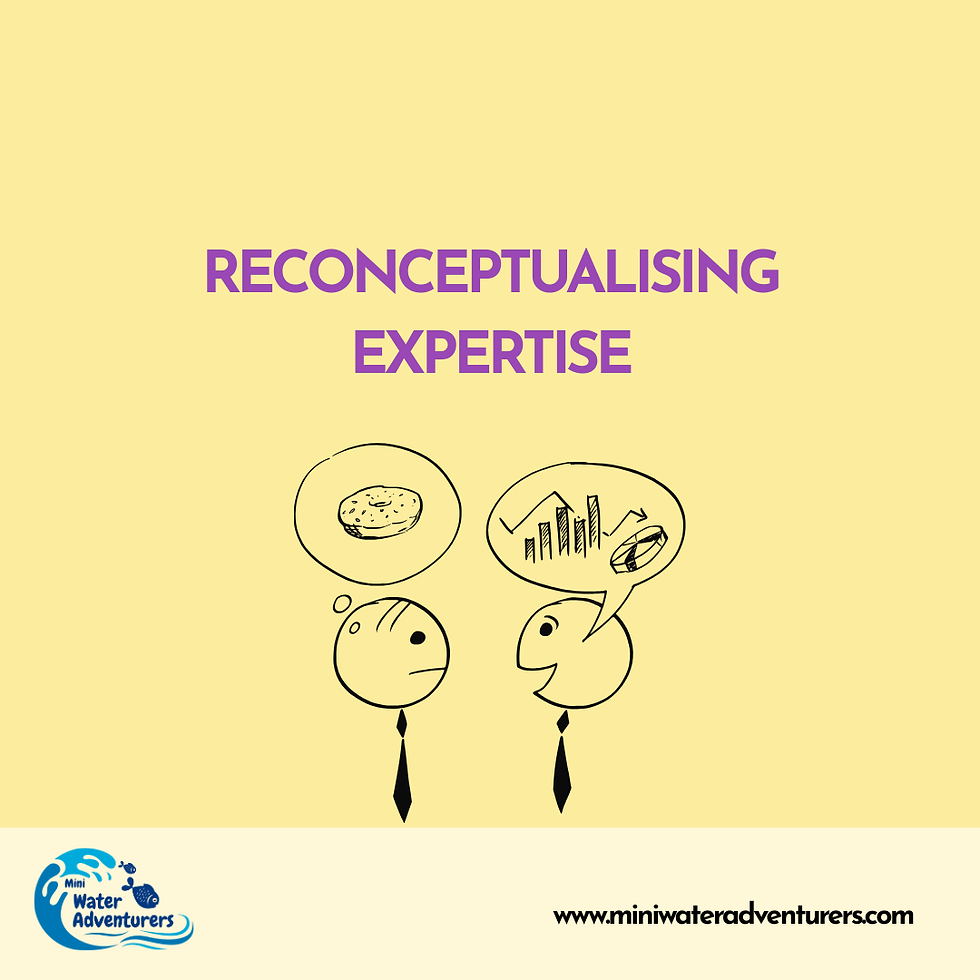
Reconceptualising expertise
The preceding discussions suggest that expertise cannot be captured by a single metric. Instead, expertise is multidimensional, comprising:
Deliberate practice and learning (Ericsson et al., 1993)
Experience contextualised by reflection (Dreyfus & Dreyfus, 1980; Schön, 1983)
Peer recognition within communities of practice (Wenger, 1998)
Contribution to tangible outcomes and impact (Collins & Evans, 2007)
This reconceptualisation highlights that expertise is emergent, situated, and relational. It is as much about what one does and how one is recognised as it is about what one publishes.
Expertise in swimming education: A case study
A fragmented field
Swimming education illustrates the contested nature of expertise. Unlike professions with centralised credentialing, aquatics is fragmented across countries and organisations. National governing bodies such as Swim England, the American Red Cross, and Swimming Australia each define their own standards and certifications. Meanwhile, independent philosophies—such as Infant Self-Rescue (ISR), Halliwick, Swim Angelfish, and play-based pedagogies—compete for legitimacy. This creates a landscape in which teachers, coaches, and innovators claim expertise through different pathways: certification, lived experience, or pedagogical innovation.
Survival-Based Programmes
One camp within swimming education is represented by survival-based programmes such as ISR, developed in the United States. ISR emphasises early mastery of survival reflexes, particularly the “flip and float” technique, designed to enable infants and toddlers to roll onto their backs and breathe independently. Expertise in ISR is defined by strict adherence to a codified curriculum and by certification from the ISR organisation. Advocates point to measurable, demonstrable skills as proof of effectiveness.
However, critics argue that survival-only approaches may be developmentally inappropriate, stressful for young children, and ethically questionable if they place infants in positions of forced self-rescue (Hughes, 2024). From this perspective, expertise is narrowly defined and risks neglecting the broader developmental, emotional, and psychological needs of children.
Play-Based and Progressive Approaches
In contrast, play-based and progressive pedagogies emphasise water competence, adaptability, and enjoyment. Langendorfer and Bruya (1995) argued that water competence extends beyond survival to include confidence, motor adaptability, and lifelong engagement with aquatic environments. Hughes (2024) advances a purposeful play approach that integrates developmental psychology, motor learning, and child-led exploration, using tools such as progressive flotation devices to scaffold independence and adaptability.
In this framework, expertise is not measured by adherence to rigid curricula but by a teacher’s ability to adapt to diverse learners, foster trust, and nurture water wisdom. Such expertise is often developed through years of reflective practice, trial, and innovation—forms of knowledge that are difficult to codify but highly valued within communities of practice.
Epistemological Divides
These contrasting approaches reveal deeper epistemological divides. Survival-based programmes legitimise expertise through certification and measurable outputs, aligning with the academic emphasis on publication. Play-based practitioners, by contrast, often gain expertise through experiential innovation and peer recognition. The conflict reflects what Collins and Evans (2007) describe as the politics of expertise: authority is claimed by controlling the narrative of what constitutes legitimate knowledge.
Communities of Practice in Aquatics
For many swimming teachers, expertise is negotiated in communities of practice rather than dictated by governing bodies. Recognition is earned through respect from peers, the trust of parents, and the demonstrable confidence and competence of swimmers. A teacher who transforms fearful toddlers into confident, water-wise children over decades of practice may hold significant authority in their community—even if their methods diverge from official curricula or lack publication.

Broader implications: swimming as a microcosm
Swimming education thus offers a microcosm of the wider expertise debate:
Plural expertise: Survival, play-based, and performance-focused approaches each define expertise differently.
Institutional vs. experiential recognition: Certification and publication validate some forms of expertise, while others remain tacit but equally legitimate.
Social contestation: Professionals resist alternative approaches, illustrating how expertise is always political.
These lessons extend beyond aquatics. Many professions undervalue practitioners whose contributions are embodied, tacit, or innovative but lack formal institutional recognition.
Conclusion
The question of when an individual becomes an expert defies singular answers. The 10,000-hour rule, years of practice, and scientific publication each capture partial dimensions of expertise but fail in isolation. Expertise is best understood as a multidimensional construct emerging from deliberate practice, reflective engagement, peer recognition, and demonstrable outcomes.
Swimming education exemplifies these tensions. In a field divided between survival-based programmes and play-based pedagogies, expertise is contested and politically negotiated. To insist that only published papers or certifications validate expertise risks marginalising practitioners whose experiential innovations profoundly impact learners.
Ultimately, expertise should not be reduced to hours, years, or publications alone. It should be judged by the integration of practice, knowledge, reflection, and community recognition—by what is both enacted and endured. In swimming, as in other professions, the lives transformed by a practitioner’s work may be the most compelling evidence of expertise.
References
Berliner, D. C. (2001). Learning about and learning from expert teachers. International Journal of Educational Research, 35(5), 463–482.
Collins, H., & Evans, R. (2007). Rethinking Expertise. Chicago: University of Chicago Press.
Dreyfus, H. L., & Dreyfus, S. E. (1980). A Five-Stage Model of the Mental Activities Involved in Directed Skill Acquisition. Washington, DC: Storming Media.
Ericsson, K. A., Krampe, R. T., & Tesch-Römer, C. (1993). The role of deliberate practice in the acquisition of expert performance. Psychological Review, 100(3), 363–406.
Eraut, M. (2000). Non-formal learning and tacit knowledge in professional work. British Journal of Educational Psychology, 70(1), 113–136.
Gladwell, M. (2008). Outliers: The Story of Success. London: Allen Lane.
Hughes, H. (2024). Tender Steps: Gradual and Developmental Swimming Activities for Babies and Young Children. Mini Water Adventurers.
Langendorfer, S. J., & Bruya, L. D. (1995). Aquatic Readiness: Developing Water Competence in Young Children. Champaign, IL: Human Kinetics.
Macnamara, B. N., Hambrick, D. Z., & Oswald, F. L. (2014). Deliberate practice and performance in music, games, sports, education, and professions: A meta-analysis. Psychological Science, 25(8), 1608–1618.
Moran, K. (2018). Can you swim? An exploration of measuring real and perceived water competency. International Journal of Aquatic Research and Education, 10(1), 1–13.
Schön, D. A. (1983). The Reflective Practitioner: How Professionals Think in Action. New York: Basic Books.
Wenger, E. (1998). Communities of Practice: Learning, Meaning, and Identity. Cambridge: Cambridge University Press.
If you’ve found this blog helpful and you're hungry for more inspiration, guidance, and tried-and-tested ideas to transform your swimming lessons, then why not take the next step? Join Helen and a growing community of passionate swimming teachers inside the SWIM Squad membership. It’s where the magic really happens – packed with exclusive resources, expert support, and a treasure trove of fresh lesson ideas to keep your teaching fun, purposeful, and progressive. Ready to dive deeper?
Click here to join us today:


Comments